Tuesday, September 14, 2010


Monday, September 13, 2010
Marketers looking to use Facebook to grow their businesses should check out Facebook Success Summit http://ow.ly/2D43h
Sunday, September 12, 2010
LM Marketers looking to use Facebook to grow their businesses should check out Facebook Success Summit http://ow.ly/2D43h
LMCA: Engagement with Prospects and Customers Throughout the Buying Cycle! Join me on this engaging event ! http://ow.ly/2xLzj
CA: Engagement with Prospects and Customers Throughout the Buying Cycle! Join me on this engaging event ! http://ow.ly/2xLzj
Saturday, September 11, 2010
LMhttp://ht.ly/2lU9i if you want the news you need to come to you instead of searching for it? . But What the hell is Digital Intuition?
Friday, September 10, 2010
Wednesday, September 08, 2010
Tuesday, September 07, 2010
Meet me at the Bucharest International exhibition for digital printing and signage http://ow.ly/2xNhG
Monday, September 06, 2010
LM Boosting Profits Through Relevance.this report boils down the essentials of 1:1 (personalized) printing that every creative and marketer needs to know http://ow.ly/2rN1E
Sunday, September 05, 2010
CA: Engagement with Prospects and Customers Throughout the Buying Cycle! Join me on this engaging event ! http://ow.ly/2xLzj
Cut travel Cost! Increase your customers visits! Grow your business!
Cut travel cost but keep a high quality customer experience! I use a free Video on-line great tool. Have a look you will be delighted by the well developed business tool. NOT USING DIMDIM YET? You can conduct your own meetings and webinars right now using the world's easiest online conference ... Dimdim! screen Share your desktop Presentation Show presentations Collaborate Collaborate live ... and much, much more Dimdim What are you waiting for? it is free have a look.
If you want to know more about your contacts inside your in box? try rapportive!
If you want to increase the quality of your lead generation email? Send something personal in your mail to knew contacts!
If you want to know more about your contacts inside your in box? This is a incredible tool? open a mail, and put your pointer on a email address and see the magic in action;-))Try "rapportive" free and impressive tool.
If you want to know more about your contacts inside your in box? This is a incredible tool? open a mail, and put your pointer on a email address and see the magic in action;-))Try "rapportive" free and impressive tool.
Saturday, September 04, 2010
Wednesday, September 01, 2010
Meet me at Graphima Belgrade Fair
Wednesday September 29, 2010, 08:00AM CEST
Ends: Saturday October 02, 2010, 05:00PM CEST
Event Type: Other
Location: Belgrade Fair ground
Војводе Мишића
Параћин, Централна Србија 35250 RS
Ends: Saturday October 02, 2010, 05:00PM CEST
Event Type: Other
Location: Belgrade Fair ground
Војводе Мишића
Параћин, Централна Србија 35250 RS
Meet me at the International exhibition for digital printing and signage in Bucharest
Starts: Wednesday September 22, 2010, 08:00AM EEST
Ends: Saturday September 25, 2010, 05:00PM EEST
Event Type: Other
Location: Bucharest Hall
Strada Garlei
Bucharest, ROMANIA RO
Ends: Saturday September 25, 2010, 05:00PM EEST
Event Type: Other
Location: Bucharest Hall
Strada Garlei
Bucharest, ROMANIA RO
CA: Engagement with Prospects and Customers Throughout the Buying Cycle! Join me on this engaging event ! http://ow.ly/2xLzj
Tuesday, August 31, 2010
Sunday, August 29, 2010
Saturday, August 28, 2010
LMhttp://ht.ly/2lU9i if you want the news you need to come to you instead of searching for it? . But What the hell is Digital Intuition?
Friday, August 27, 2010
Thursday, August 26, 2010
Monday, August 23, 2010
LM"The man who does more than he is paid for will soon be paid for more than he does." http://ow.ly/2teZw
Saturday, August 21, 2010
LMhttp://ht.ly/2lU9i if you want the news you need to come to you instead of searching for it? . But What the hell is Digital Intuition?
Thursday, August 19, 2010
VDP Solutions Review
This white paper, an update of a study done in 2006 by Dr. John Leininger of Clemson University, focuses on a central element in the variable-data workflow: the applications that merge data with layouts and prepare variable documents for printing. As a simple Google search will show, there are a significant number of VDP solutions currently on the market, and all seem to offer slightly different levels of functionality. We hope that this white paper will serve as a useful guide for navigating through this wide market.
Table of Contents
* Introduction
* AE Solutions—Printimate
* Atlas Software—PrintShop Mail
* Bitstream—Pageflex
* DirectSmile—DirectSmile
* Document Sciences/EMC2—xPression 3
* Elixir Technologies—Opus
* Exstream Software/HP—Dialogue
* GLUON—HyperMatrix
* GMC Software Technology—PrintNet
* HP Indigo—Yours Truly Designer
* Kodak—Darwin VI
* Lexigraph—pdfExpress
* Lytrod—Proform Designer
* Meadows Publishing Solutions—DesignMerge
* Printable Technologies—FusionPro
* Responsive Solutions—Customer+
* Saepio Technologies—Dynamic Content Engine
* Xerox—Free Flow Variable VI Suite
* XMPie—XMPie
You can get this report from What they think
* Published by: Printing Industries of America
Table of Contents
* Introduction
* AE Solutions—Printimate
* Atlas Software—PrintShop Mail
* Bitstream—Pageflex
* DirectSmile—DirectSmile
* Document Sciences/EMC2—xPression 3
* Elixir Technologies—Opus
* Exstream Software/HP—Dialogue
* GLUON—HyperMatrix
* GMC Software Technology—PrintNet
* HP Indigo—Yours Truly Designer
* Kodak—Darwin VI
* Lexigraph—pdfExpress
* Lytrod—Proform Designer
* Meadows Publishing Solutions—DesignMerge
* Printable Technologies—FusionPro
* Responsive Solutions—Customer+
* Saepio Technologies—Dynamic Content Engine
* Xerox—Free Flow Variable VI Suite
* XMPie—XMPie
You can get this report from What they think
* Published by: Printing Industries of America
Wednesday, August 18, 2010
Tuesday, August 17, 2010
Thursday, August 12, 2010
Make Your Knowledge Sell! and build your Brand Online
You -- Yes, You -- Can Write
A Profitable E-book!
Really? You, write a book? A saleable manual? A how-to guide? Yes, you can! There's an e-book in everyone. And yours is based on what you already know.
After all, you're unique, right?
You know stuff other people don't... things people would pay to know.
So you're already very close to profiting from your knowledge.
Now you just need to know...
* How to pull it out of your brain
* How to publish it
* How to sell it on the Net
In other words, how to Make Your Knowledge Sell!
"Turn knowledge into revenue -- sell "what you know" on the Net."
A Profitable E-book!
Really? You, write a book? A saleable manual? A how-to guide? Yes, you can! There's an e-book in everyone. And yours is based on what you already know.
After all, you're unique, right?
You know stuff other people don't... things people would pay to know.
So you're already very close to profiting from your knowledge.
Now you just need to know...
* How to pull it out of your brain
* How to publish it
* How to sell it on the Net
In other words, how to Make Your Knowledge Sell!
"Turn knowledge into revenue -- sell "what you know" on the Net."
Tuesday, August 10, 2010
Printer’s Survival Kit: Understand & Participate in the Digital Economy
By Jennifer Matt
Published: August 10, 2010
Print is a major player in the information business. Everything that is printed communicates information for various purposes, including promotion, entertainment, education, transaction, etc. Today's digital technologies are changing virtually everything about the information business.
The information business is simultaneously operating in two economies - rapidly transitioning from the "atoms" based economy to the "bits" based economy. Nicholas Negroponte first introduced the concept of an "atoms" and "bits" economy in his 1996 book Being Digital. Negroponte stated that the world had been based on an economy of "atoms" (physical stuff that we dream up, manufacture, and distribute, a slow moving, "human handling" economy), whereas the future is about the "bits" economy or digital economy which is "...instantaneous and inexpensive transfer of bits at the speed of light."
Print is part of the atoms economy (physical stuff). In the atoms economy, we create content and distribute it via atoms (books, newspapers, magazines, mail, flyers, signage). Now the information business has a new distribution system, because virtually every product sold in the information business can be rendered in a digital form.
We advise printers to become marketing service providers in order to diversify from a 100% print manufacturing revenue stream. Negroponte would say that printers need to figure out a way to render a portion of their information products in digital form in order to participate in the bits economy. Atoms-based economies aren't going away-many of them cannot be rendered in a digital form (food, shelter, etc...) - but we work in the market that is most impacted by this monumental change because the entire information business is perfectly suited for digital distribution. Don't mistake the digital/bits economy with digital printing; all print is still very much atoms-based (physical stuff).
Remember all the hype in the 90's about the potential of the internet? Most of it had to do with the fact that we didn't understand the implications of a distribution system that is deflationary (the costs are rapidly decreasing). Yes, I'll say that again. The costs of distribution in the digital economy are getting cheaper, at a rapid pace. Chris Anderson, in his book Free, says, "racing towards the inevitable radical price of free." It will cost Google 50% less to stream that YouTube video next year (bandwidth costs); it will cost Google 50% less to host your Gmail account next year (storage costs).
In the 90's we thought we could reap the benefits of the bits economy simply by online-enabling procurement in the atoms economy (pets.com - dog food happens to be very heavy atoms). There's no way to render dog food into a digital product; hence, the only real efficiencies were in the ability for your customers to order online. Pets.com imploded because the world didn't need another atoms-based distribution system for dog food. On the other hand, Amazon thrives, because creating an unlimited inventory in the information market is a huge benefit even if you're shipping atoms. Now with the Kindle, Amazon has rendered its core product into a pure digital form to maximize its use of the digital economy. In July 2010, Amazon reported that Kindle sales (digital economy) now outpace books (atoms economy) for the company.
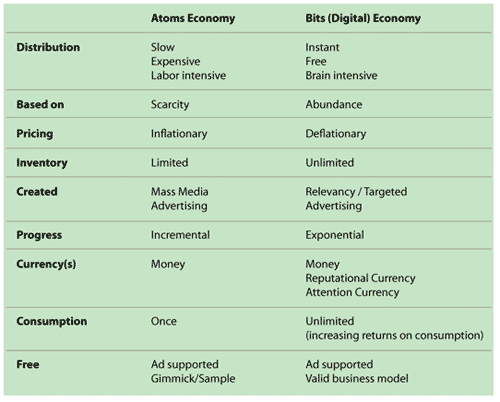 A distribution system that has unlimited inventory and whose cost of distribution is deflationary creates an economy based on abundance rather than scarcity. In the atoms-based information market, prices are based on scarcity; there are only so many TV spots you can sell during the Super Bowl, there is space for only so many ads in a magazine, etc. An abundant economy includes an unlimited number of books (Amazon), unlimited number of songs (iTunes), unlimited content (blogs, wikis, websites) because the cost of incremental additions is essentially too low to measure.
In 2006, Chris Anderson explained this brilliantly in his book, The Long Tail. What do unlimited inventories do to product selection and the whole idea of blockbusters? Because iTunes can provide music for the smallest niche - for example, one of my favorites - Indian Jazz Fusion - Anderson states that the Long Tail represents "...the end of the monopoly of the blockbuster, as hits are forced to share the stage with countless niche products targeting narrow consumer demand." Michael Jackson's Thriller album was a blockbuster partly because we had a limited inventory to choose from (the top 5,000 albums). Today we have access to our true niche tastes (e.g., the local band) because the digital economy allows companies to service the niche market as effectively as it serviced the mass market.
If you're feeling overwhelmed, put your seat belts on because the rate of change in the digital economy is exponential. The digital world combines incremental improvements with breakthrough inventions to give it a much steeper evolutionary curve. Moore's Law states: "...the number of transistors that can be placed on an integrated circuit has doubled approximately every two years," and is the most famous example of exponential progress in the digital world. Anderson points out, "the price of bandwidth and storage is dropping even faster."
The atoms economy is moving incrementally; the bits economy is moving exponentially. One side effect of these differences in pace is that the participants in each economy have different comfort levels with change. Bits economy people view change as ubiquitous and fast; atoms economy people see change as incremental and slow. One embraces change; the other is cautious and frequently resistant.
The software market is a good example. Today software is typically sold in two primary ways: On Premises License or Software as a Service (SaaS) Subscription. There is still an active debate in the print industry about licensing versus subscription which I have covered extensively at WhatTheyThink's The Web and Print blog. While we in the atoms based economy are debating this issue, the bits economy has evolved to yet another revolutionary invention that radically increases efficiencies and decreases costs of software deployment - cloud computing. Cloud computing is the ultimate global pooling of resources - rent only what you need (bandwidth, storage, processing power) in per minute increments. The US government estimates the average server utilization in its 1,100 data centers is 7%, an unbelievable amount of waste in several critical resource pools, power being the most obvious one. Pooling those resources in a cloud computing model would enable the government to pay for only the resources it consumes, representing an incredible savings in hardware, software, and energy.
While printers still grapple with decisions about On Premises versus SaaS, the digital economy is racing towards further optimization. Maybe one of the most important lessons we can learn from the bits economy is that we must embrace change or be left in the dust!
Abundance economy built on bits and a free distribution system creates a very different kind of free. Yes, we still have the ad-supported free. Google is the poster child for ad-supported "free to me" on the web. We think of Google as a software company, but Google has a very traditional media business model. The New York Times sells readers to advertisers (mass media); Google sells individual user intent to advertisers (relevance media). The advertisers on Google pay so that we can search for free. Traditional media companies keep saying online advertising is destroying their business. Online advertising is rapidly demonetizing the atoms-based information market because mass media is inefficient, bothering 90% of us to find the few who are interested in the product. Think denture commercials watched by your kids. Google's search delivers relevance at the individual level which is a better mouse trap AND it opens advertising up to a much bigger market.
The mass media approach had so much waste that only the deepest pockets could afford it. Today if you are a bonsai tree specialist in San Francisco, you can afford to advertise online because Google only charges you when someone clicks (very little waste).
Probably the most radical implication of this new economy is a viable business model that is based on giving your product/service away for free. Not the gimmicky free of yesterday, but a genuine free to most of the users of the solution forever. Thus the name "freemium" gets introduced into the Web 2.0 lexicon.
WhatTheyThink runs on a combination of freemium and premium (ad supported). The majority of viewers are free forever (supported by both ads and premium member subscription). Online video games are another model where the majority of players play forever without spending any money, subsidized by those players who choose "premium" paid-for options.
The Web 2.0 software version of freemium interests me the most. There is a tremendous amount of free services available today via this model that provide real value for the long term for the majority of users. It runs the full gamut, from project management software such as 37 Signals' Basecamp to MailChimp's e-mail campaign software. I recently counted the number of freemium models I use today - the current total is about 50 services that I use on a semi-regular basis without paying anything. Watch the Land o' Freemium section of "The Web and Print" for reviews of the most valuable software tools you can use via the freemium model.
A successful freemium business model typically shoots for at least a 5% conversion of users to its "premium" offer. The key to this business model is multi faceted. Servicing the 95% has to be very close to free (think brilliantly easy-to-use software because support costs will kill you), and then think scale. This model only works if you can scale it and therefore the 5% conversion is a meaningful number. Some of these companies combine freemium with ad supported revenue streams, but there are 100% freemium business models working today where they are building successful business by giving away their services to 95% of their customers! – Amazing!
When change occurs, opportunity knocks and there is also fallout. One of the strangest terms I read in Anderson's book was "rapid market demonetization." The examples are startling. Consider the encyclopedia market as described by venture capitalist Josh Kopelman. Britannica was the leader of this $1.2 billion industry (1991). In 1993 Microsoft launched Encarta. De-monetization works like this: the encyclopedia market was cut in half in less than three years, "...every dollar of Microsoft's gain caused an asymmetrical amount of pain in the marketplace. They made money by shrinking the market."
Print (along with other atoms-based economies in the information business) is experiencing a form of demonetization; as new digital distribution companies are created the market for atoms-based information shrinks.
Print manufacturing will always be a physical product (atoms economy) but that doesn't mean that printers can't leverage the advantages of the digital economy in their businesses. Staying competitive in the atoms economy requires that you learn the efficiencies of the bits economy. The best published example I've heard of comes from the oldest continuously publishing newspaper in the world, The Daily Telegraph. I wrote about Toby Wright, CTO, in The Web and Print. He moved to a 100% SaaS software model with his IT infrastructure in the Cloud, drastically reducing costs and enabling The Daily Telegraph to focus on the core activity of creating valuable content for its readers. In order to remain competitive, atoms-based businesses must leverage all the advantages of the bits-based economy.
Change impacts each of us individually. The authors quoted in this article have enabled me to understand the roots of this transition from an atoms-based economy to a bits-based economy and how this impacts the print industry. Understanding this global transition helps me navigate better as well as to help others chart a course that inspires rather than paralyzes. What will your reaction to this change be? How can the industry collectively inspire the ability to embrace change rather than build defenses around yesterday? Food for thought ...
Published: August 10, 2010
Print is a major player in the information business. Everything that is printed communicates information for various purposes, including promotion, entertainment, education, transaction, etc. Today's digital technologies are changing virtually everything about the information business.
The information business is simultaneously operating in two economies - rapidly transitioning from the "atoms" based economy to the "bits" based economy. Nicholas Negroponte first introduced the concept of an "atoms" and "bits" economy in his 1996 book Being Digital. Negroponte stated that the world had been based on an economy of "atoms" (physical stuff that we dream up, manufacture, and distribute, a slow moving, "human handling" economy), whereas the future is about the "bits" economy or digital economy which is "...instantaneous and inexpensive transfer of bits at the speed of light."
Print is part of the atoms economy (physical stuff). In the atoms economy, we create content and distribute it via atoms (books, newspapers, magazines, mail, flyers, signage). Now the information business has a new distribution system, because virtually every product sold in the information business can be rendered in a digital form.
We advise printers to become marketing service providers in order to diversify from a 100% print manufacturing revenue stream. Negroponte would say that printers need to figure out a way to render a portion of their information products in digital form in order to participate in the bits economy. Atoms-based economies aren't going away-many of them cannot be rendered in a digital form (food, shelter, etc...) - but we work in the market that is most impacted by this monumental change because the entire information business is perfectly suited for digital distribution. Don't mistake the digital/bits economy with digital printing; all print is still very much atoms-based (physical stuff).
Remember all the hype in the 90's about the potential of the internet? Most of it had to do with the fact that we didn't understand the implications of a distribution system that is deflationary (the costs are rapidly decreasing). Yes, I'll say that again. The costs of distribution in the digital economy are getting cheaper, at a rapid pace. Chris Anderson, in his book Free, says, "racing towards the inevitable radical price of free." It will cost Google 50% less to stream that YouTube video next year (bandwidth costs); it will cost Google 50% less to host your Gmail account next year (storage costs).
In the 90's we thought we could reap the benefits of the bits economy simply by online-enabling procurement in the atoms economy (pets.com - dog food happens to be very heavy atoms). There's no way to render dog food into a digital product; hence, the only real efficiencies were in the ability for your customers to order online. Pets.com imploded because the world didn't need another atoms-based distribution system for dog food. On the other hand, Amazon thrives, because creating an unlimited inventory in the information market is a huge benefit even if you're shipping atoms. Now with the Kindle, Amazon has rendered its core product into a pure digital form to maximize its use of the digital economy. In July 2010, Amazon reported that Kindle sales (digital economy) now outpace books (atoms economy) for the company.
Two Economies
In 2006, Chris Anderson explained this brilliantly in his book, The Long Tail. What do unlimited inventories do to product selection and the whole idea of blockbusters? Because iTunes can provide music for the smallest niche - for example, one of my favorites - Indian Jazz Fusion - Anderson states that the Long Tail represents "...the end of the monopoly of the blockbuster, as hits are forced to share the stage with countless niche products targeting narrow consumer demand." Michael Jackson's Thriller album was a blockbuster partly because we had a limited inventory to choose from (the top 5,000 albums). Today we have access to our true niche tastes (e.g., the local band) because the digital economy allows companies to service the niche market as effectively as it serviced the mass market.
If you're feeling overwhelmed, put your seat belts on because the rate of change in the digital economy is exponential. The digital world combines incremental improvements with breakthrough inventions to give it a much steeper evolutionary curve. Moore's Law states: "...the number of transistors that can be placed on an integrated circuit has doubled approximately every two years," and is the most famous example of exponential progress in the digital world. Anderson points out, "the price of bandwidth and storage is dropping even faster."
The atoms economy is moving incrementally; the bits economy is moving exponentially. One side effect of these differences in pace is that the participants in each economy have different comfort levels with change. Bits economy people view change as ubiquitous and fast; atoms economy people see change as incremental and slow. One embraces change; the other is cautious and frequently resistant.
The software market is a good example. Today software is typically sold in two primary ways: On Premises License or Software as a Service (SaaS) Subscription. There is still an active debate in the print industry about licensing versus subscription which I have covered extensively at WhatTheyThink's The Web and Print blog. While we in the atoms based economy are debating this issue, the bits economy has evolved to yet another revolutionary invention that radically increases efficiencies and decreases costs of software deployment - cloud computing. Cloud computing is the ultimate global pooling of resources - rent only what you need (bandwidth, storage, processing power) in per minute increments. The US government estimates the average server utilization in its 1,100 data centers is 7%, an unbelievable amount of waste in several critical resource pools, power being the most obvious one. Pooling those resources in a cloud computing model would enable the government to pay for only the resources it consumes, representing an incredible savings in hardware, software, and energy.
While printers still grapple with decisions about On Premises versus SaaS, the digital economy is racing towards further optimization. Maybe one of the most important lessons we can learn from the bits economy is that we must embrace change or be left in the dust!
Free
Anderson's contribution in Free is the latest chapter of this story. He builds on Negroponte's atoms-versus-bits distinction and his own ideas around The Long Tail. Anderson brilliantly describes the results of the digital economy on the business model of Free: "While the last century's 'Free' was a powerful marketing method, this century's 'Free' is an entirely new economic model."Abundance economy built on bits and a free distribution system creates a very different kind of free. Yes, we still have the ad-supported free. Google is the poster child for ad-supported "free to me" on the web. We think of Google as a software company, but Google has a very traditional media business model. The New York Times sells readers to advertisers (mass media); Google sells individual user intent to advertisers (relevance media). The advertisers on Google pay so that we can search for free. Traditional media companies keep saying online advertising is destroying their business. Online advertising is rapidly demonetizing the atoms-based information market because mass media is inefficient, bothering 90% of us to find the few who are interested in the product. Think denture commercials watched by your kids. Google's search delivers relevance at the individual level which is a better mouse trap AND it opens advertising up to a much bigger market.
The mass media approach had so much waste that only the deepest pockets could afford it. Today if you are a bonsai tree specialist in San Francisco, you can afford to advertise online because Google only charges you when someone clicks (very little waste).
Probably the most radical implication of this new economy is a viable business model that is based on giving your product/service away for free. Not the gimmicky free of yesterday, but a genuine free to most of the users of the solution forever. Thus the name "freemium" gets introduced into the Web 2.0 lexicon.
WhatTheyThink runs on a combination of freemium and premium (ad supported). The majority of viewers are free forever (supported by both ads and premium member subscription). Online video games are another model where the majority of players play forever without spending any money, subsidized by those players who choose "premium" paid-for options.
The Web 2.0 software version of freemium interests me the most. There is a tremendous amount of free services available today via this model that provide real value for the long term for the majority of users. It runs the full gamut, from project management software such as 37 Signals' Basecamp to MailChimp's e-mail campaign software. I recently counted the number of freemium models I use today - the current total is about 50 services that I use on a semi-regular basis without paying anything. Watch the Land o' Freemium section of "The Web and Print" for reviews of the most valuable software tools you can use via the freemium model.
A successful freemium business model typically shoots for at least a 5% conversion of users to its "premium" offer. The key to this business model is multi faceted. Servicing the 95% has to be very close to free (think brilliantly easy-to-use software because support costs will kill you), and then think scale. This model only works if you can scale it and therefore the 5% conversion is a meaningful number. Some of these companies combine freemium with ad supported revenue streams, but there are 100% freemium business models working today where they are building successful business by giving away their services to 95% of their customers! – Amazing!
When change occurs, opportunity knocks and there is also fallout. One of the strangest terms I read in Anderson's book was "rapid market demonetization." The examples are startling. Consider the encyclopedia market as described by venture capitalist Josh Kopelman. Britannica was the leader of this $1.2 billion industry (1991). In 1993 Microsoft launched Encarta. De-monetization works like this: the encyclopedia market was cut in half in less than three years, "...every dollar of Microsoft's gain caused an asymmetrical amount of pain in the marketplace. They made money by shrinking the market."
Print (along with other atoms-based economies in the information business) is experiencing a form of demonetization; as new digital distribution companies are created the market for atoms-based information shrinks.
Print manufacturing will always be a physical product (atoms economy) but that doesn't mean that printers can't leverage the advantages of the digital economy in their businesses. Staying competitive in the atoms economy requires that you learn the efficiencies of the bits economy. The best published example I've heard of comes from the oldest continuously publishing newspaper in the world, The Daily Telegraph. I wrote about Toby Wright, CTO, in The Web and Print. He moved to a 100% SaaS software model with his IT infrastructure in the Cloud, drastically reducing costs and enabling The Daily Telegraph to focus on the core activity of creating valuable content for its readers. In order to remain competitive, atoms-based businesses must leverage all the advantages of the bits-based economy.
Change impacts each of us individually. The authors quoted in this article have enabled me to understand the roots of this transition from an atoms-based economy to a bits-based economy and how this impacts the print industry. Understanding this global transition helps me navigate better as well as to help others chart a course that inspires rather than paralyzes. What will your reaction to this change be? How can the industry collectively inspire the ability to embrace change rather than build defenses around yesterday? Food for thought ...
Monday, August 09, 2010
HP CEO Mark Hurd Resigns Unexpectedly Amid Scandal (UPDATED) | Epicenter | Wired.com
HP CEO Mark Hurd Resigns Unexpectedly Amid Scandal (UPDATED) | Epicenter | Wired.com: "– Envoyé à l'aide de la barre d'outils Google"
Tuesday, August 03, 2010
Global Digital Out-of-Home Media Forecast 2008-2012 AVAILABLE NOW
Key Questions Answered:
- What defines digital out-of-home media?
- What historical trends have driven double-digit growth in the US and worldwide by region?
- Which sub-segments will see the fastest growth and when?
- What technological advances drive growth?
- How will new measurement standards impact the industry?
- How does National vs Local advertising share differ by sub-segment?
- How much is being spent by ad categories by sub-segment?
- What criteria are most/least important to buyers of video advertising networks?
- What's the long-term growth potential for each sub-segment through 2012?
- Who are the leaders, key players and emerging companies to watch?
- How will the gold rush, shakeout, and anticipated breakout shape the future of the industry?
Global History, Spending, Trends & Analysis (click here for report)
As the global economy continues to weaken, traditional media advertising dollars continue their migration to alternative media, and specifically digital out-of-home (OOH), in the US and abroad, as the seminal transition taking place across the media landscape continues to accelerate.This first-ever primary research into the global digital OOH market, reports rapid growth of 22% to $5.4 billion in 2007, and an anticipated increase of 13% to $6.1 billion in 2008. However, after growing at over 20 percent every year from 2002-2007, US growth in digital OOH media is expected to go through a shakeout, with a dip to 9.1% in 2009, bouncing back to 12.8% in 2010 as conditions improve. The US accounts for 40% of the global DOOH industry, but that percentage is expected to decline over time. Key international markets include the UK, Japan, France, Germany, Russia, and China, with the Chinese market benefitting from the impact and innovation of Olympic marketing.
This exclusive 125 page report is intended to provide media stakeholders with unique global strategies for first mover advantage and growth through its breadth of data, analysis and commentary on this potentially game-changing platform. It includes 24 tables & charts, more than 1,000 digital OOH providers identified by sub-segment, 600 from the US, as well as a convenient summary of the just released Out-of-home Advertising Bureau (OVAB) Audience Metrics Guidelines.
Global Digital Out-of-Home Media Forecast 2009-2014 new report available NOW
Global History, Spending, Trends & Analysis report available NOW (click here)
Amid a sharp downturn in global advertising spending and a decline in traditional out-of-home advertising in 2009, digital out-of-home media is among the fastest growing media in the world and will continue on an upward track in 2010, according to a new global forecast from PQ Media, the leading provider of media econometrics.Throughout history, emerging media supported by strong audience metrics have consistently grown during economic recoveries after deep recessions. This was true for radio in the '30s and '40s, broadcast TV in the '50s, cable TV in the '80s and '90s, and Internet and search in the '00s. PQ Media data strongly suggest history will repeat itself in the case of digital out-of-home media, due in part to today's unprecedented media disruption and fragmentation, people consuming more media out of the home all day long, and with media stakeholders placing greater emphasis on audience measurement.
While the rate of growth has gone through a "gold rush" and a PQ Media predicted "shakeout" phase, with decelerated growth for the second consecutive year, the report anticipates U.S. spending will grow 2.0% to $2,469 billion in 2009, with worldwide spending up 4.7% to $6.69 billion. Starting in 2010, PQ Media forecasts digital OOH will move into a "breakout" phase and grow at a compound annual rate of 9.4% through 2014 in the U.S. and 10.1% globally. During the forecast period, many video advertising network and digital billboard sub-segments are anticipated to see double-digit growth in spending.
The digital OOH media sector was first identified and defined by PQ Media in 2007. The PQ Media Global Digital Out-of-Home Media Forecast 2009-2014 is the most comprehensive and respected source of strategic intelligence used by leading digital OOH operators, financial companies, brands and agencies, due to its breadth and depth of data and analysis.
The digital OOH media sector was first identified and defined by PQ Media in 2007. The PQ Media Global Digital Out-of-Home Media Forecast 2009-2014 is the most comprehensive and respected source of strategic intelligence used by leading digital OOH operators, financial companies, brands and agencies, due to its breadth and depth of data and analysis.
The much anticipated 2009 edition covers 15 countries in the Americas, Eastern Europe/Middle East/Africa and Asia/Pacific; has been expanded to reflect input from more than 650 digital OOH companies; presents exclusive findings and predictive analysis and runs 185 pages with more than 30 data tables & charts, as well as the largest collection of digital OOH company profiles with contact information ever assembled. Detailed drill-down segment and sub-segment data from PQ Media's deep repository of proprietary spending and media usage databases provide media stakeholders with the essential planning tools for developing sound strategic initiatives in an evolving digital OOH media space.
Exclusive History, Spending, Trends and Analysis Available No Place Else:
- Definitions & Segmentation:
- Video Advertising Networks (VANs) – In-Theater, In-Retail, In-Office, In-Entertainment, In-Transit
- Digital Billboards and Ambient Advertising – At-Road, At-Transit, At-Entertainment, At-Retail
- US and Global digital OOH Media Spending Analysis 2004-2014
- Global Regions Covered: US, Canada, Latin America, Western Europe, Eastern Europe/Middle East/Africa, Asia/Pacific
- Countries Covered: US, Canada, Brazil, UK, Germany, France, Spain, Italy, Russia, Middle East & Africa, Japan, China, South Korea, Australia, India
- Digital OOH Share of Overall Out-of-Home Media Spending
- Top 20 Video Advertising Network Providers
- Top 20 Digital Billboard Providers
- Top 10 Trends Driving DOOH Going Forward
- Digital OOH Spending by Company Cluster - Top 10, 11-25, 26-50, etc.
- Share of Digital OOH Spending by Company Size - Over $100 Million, $50-$100 Million, etc.
- Digital OOH Spending by Ad Categories 2009
- Share of Digital OOH Spending by Segment
- Share of Digital OOH Spending in 2009 - National vs Local
- VAN Spending 2004-2014
- Digital Billboard Spending 2004-2014
- VAN Share of Digital OOH Spending 2009
- Global digital OOH Media Spending Analysis - Americas, EMEA, Asia/Pacific
- Global digital OOH Spending and Share by Region and 15 Selected Countries
- Share of VAN Visitors with Income Over $100,000
- Time Spent Annually with Media Per Person - 1984 vs 2008
- Number of Visitors Per Venue Type, Visits Per Year and Avg. Minutes Per Visit
- Number of At-Road Digital Billboards 2004-2014
- Number of Commuters and Time Spent Commuting
- Pro Sports Attendance 1985 – 2009
- Estimated Consumer Interaction with VANs Per Month
- Comparative CPM Rate Ranges by Medium
Appendix
Digital Out-of-Home Venue Types
Demographic Profile of Digital Out-of-Home Audiences
Share of Select Demographics by Select Venues
Digital Out-of-Home Company Profiles
Retailers with Digital Networks
Digital OOH Mergers & Acquisitions and Closures
Global Digital OOH Companies
Demographic Profile of Digital Out-of-Home Audiences
Share of Select Demographics by Select Venues
Digital Out-of-Home Company Profiles
Retailers with Digital Networks
Digital OOH Mergers & Acquisitions and Closures
Global Digital OOH Companies
SCREENS.tv - Digital Signage News
SCREENS.tv - Digital Signage News: "– Envoyé à l'aide de la barre d'outils Google"
Thursday, July 29, 2010
Hello
So everyone and his (or her) dog seems to be talking about Twitter these days, right?
And while millions of people around the world are tweeting, twitting or twotting – many people still consider the Twitter groupies a bunch of twits.
Today I thought I'd send you 5 reasons why you should stay strong with your twit-mentality and avoid the Twitter bandwagon like the plague.
1) You Don’t Have Time
Your schedule is jam-packed every single day. You’re struggling to just break even with your task list. You barely have time to take a toilet break, let alone build relationships that could open you up into a whole new world of business connections and potential revenue.
2) You Have Enough Money
You’ve got exactly the right amount of money. You don’t want a single dime more. You want your income to stay exactly where it is, no ifs or buts. Any extra revenue to be made from forging new business partnerships or projects on Twitter would just make you angry.
3) You’ve Got All The Friends You Need
You have got enough friends. They all have their place in your life and you don’t want to interrupt the pattern and add a single other friend to the mix. You don’t want to meet anyone from another country, share a conversation with a multi-millionaire or learn anything new from anyone – you’ll stick to your non-Twit friends, thanks.
4) You Don’t Want The Attention
You’re not interested in getting all the attention. You like being the mysterious underground player and letting the limelight-seekers’ websites receive the exposure. Let ‘em have it, you say, I’m fine with my current customer base. I don’t want anyone else to know about us who doesn’t already have our business card in their filofax.
5) You’re Not Interested In Breaking News
You hate breaking news. You hate having to hear about it before any of the news crews get abreast of it. You hate having to read about it as it’s happening. You like knowing that tomorrow, when its all died down, you will be able to read a brief summary of events from a single journalist in Washington as you eat your cereal.
Don’t worry, I totally understand where you’re coming from.
I mean… what does Guy Kawasaki, the NY Times or Oprah know about business or making money anyway...
{Side note: I sincerely hope you understood the sarcasm of this email and immediately sign up for a Twitter account and follow me at Lucien08}
Talk to you soon ;-)
So everyone and his (or her) dog seems to be talking about Twitter these days, right?
And while millions of people around the world are tweeting, twitting or twotting – many people still consider the Twitter groupies a bunch of twits.
Today I thought I'd send you 5 reasons why you should stay strong with your twit-mentality and avoid the Twitter bandwagon like the plague.
1) You Don’t Have Time
Your schedule is jam-packed every single day. You’re struggling to just break even with your task list. You barely have time to take a toilet break, let alone build relationships that could open you up into a whole new world of business connections and potential revenue.
2) You Have Enough Money
You’ve got exactly the right amount of money. You don’t want a single dime more. You want your income to stay exactly where it is, no ifs or buts. Any extra revenue to be made from forging new business partnerships or projects on Twitter would just make you angry.
3) You’ve Got All The Friends You Need
You have got enough friends. They all have their place in your life and you don’t want to interrupt the pattern and add a single other friend to the mix. You don’t want to meet anyone from another country, share a conversation with a multi-millionaire or learn anything new from anyone – you’ll stick to your non-Twit friends, thanks.
4) You Don’t Want The Attention
You’re not interested in getting all the attention. You like being the mysterious underground player and letting the limelight-seekers’ websites receive the exposure. Let ‘em have it, you say, I’m fine with my current customer base. I don’t want anyone else to know about us who doesn’t already have our business card in their filofax.
5) You’re Not Interested In Breaking News
You hate breaking news. You hate having to hear about it before any of the news crews get abreast of it. You hate having to read about it as it’s happening. You like knowing that tomorrow, when its all died down, you will be able to read a brief summary of events from a single journalist in Washington as you eat your cereal.
Don’t worry, I totally understand where you’re coming from.
I mean… what does Guy Kawasaki, the NY Times or Oprah know about business or making money anyway...
{Side note: I sincerely hope you understood the sarcasm of this email and immediately sign up for a Twitter account and follow me at Lucien08}
Talk to you soon ;-)
Wednesday, July 28, 2010
Digital printer Second hand Market place
Scitex Pressjet II, 6-colour ready packed on pallets from 2006 full printing condition
60.000 euro ex works Europe perfect to add capacity to a current PJ owner

the high production wide format digital press, which promises to meet growing market demands for advanced color quality and multi-application flexibility.
Targeted at the graphic arts market, the Scitex Pressjet II represents a new generation of the Scitex Pressjet. Six-color printing (CMYK with the addition of light cyan and light magenta) make it possible to attain the highest image quality. Printing houses will also benefit from Onyx Postershop RIP, which offers a faster and simpler workaround, and provides new color management options.
60.000 euro ex works Europe perfect to add capacity to a current PJ owner

the high production wide format digital press, which promises to meet growing market demands for advanced color quality and multi-application flexibility.
Targeted at the graphic arts market, the Scitex Pressjet II represents a new generation of the Scitex Pressjet. Six-color printing (CMYK with the addition of light cyan and light magenta) make it possible to attain the highest image quality. Printing houses will also benefit from Onyx Postershop RIP, which offers a faster and simpler workaround, and provides new color management options.
Tuesday, July 27, 2010
A video showing how we grew our customer in super wide format printing business since 1996 with Scitex and HP printers
http://ht.ly/2h8fa
http://ht.ly/2h8fa
Monday, July 26, 2010
Digital printer Second hand Market place
For Sale, ready packed (Printer must go urgently customer need space)
HP Scitex XL jet 1500 Digital printer second hand looking for a new home
Customer in west Europe
XL 1500 5m 8 colours upgraded till last model, and service Coverage since 23/08/2001 .
HP Scitex XL jet 1500 Digital printer second hand looking for a new home
Customer in west Europe
XL 1500 5m 8 colours upgraded till last model, and service Coverage since 23/08/2001 .
This info was validate with the EMEA Product support manager in that time.
Saturday, July 24, 2010
Thursday, July 15, 2010
Monday, July 12, 2010
From Hotel Mazagan Marocco. : 'Facebook Is a Dinner Party'
http://www.viralnetworkers.com/forum/topic/show?id=4523559%3ATopic%3A37927

Monday, June 28, 2010
Wednesday, June 16, 2010
See you at : 1000 Party@FESPA the 22 June at 20H00

1000 Party@FESPA
Time: 19:30
Place: Augustiner-Keller ,
Arnulfstrasse 52 , 80335 Munich,
www.augustinerkeller.de
Who: All Customers
Monday, June 14, 2010
Let us meet at FESPA
We can meet at the HP booth Hall B2, Stand 120
the 24 at 14H
· 14:00 Meeting at HP booth with you
· 14:30-16:00 Presentation “HP solution package for CEE marketplace”
· 16:30-18:00 Come&See HP@FESPA (HP booth demos)
the 24 at 14H
· 14:00 Meeting at HP booth with you
· 14:30-16:00 Presentation “HP solution package for CEE marketplace”
· 16:30-18:00 Come&See HP@FESPA (HP booth demos)
Sunday, June 13, 2010
Thursday, June 10, 2010
World Cup Schedule Printable: World Cup 2010 Kicks off Tomorrow
World Cup Schedule Printable: World Cup 2010 Kicks off Tomorrow: "– Envoyé à l'aide de la barre d'outils Google"
Monday, June 07, 2010

Wednesday, June 02, 2010
Saturday, May 29, 2010
Friday, May 28, 2010

Is Bullishness at IPEX a Positive Sign?
By Dr. Joe Webb on May 25th, 2010
The reports from IPEX have been very enthusiastic. Most all reports from any show floor, in my 33 years in the industry, are positive, no matter what the facts seem to be. It’s our nature, especially when our industry’s owners and suppliers are all in one place. But these reports from IPEX seem to stand apart.
I was not there, nor have I ever been to an IPEX, so I can’t offer my own assessment. The idea of such bullishness it got me thinking (that’s usually dangerous).
What if the show really is a change in sentiment, and that sentiment is based on a true upward turn in the fortunes of print businesses. If so, then what was it that happened? Did anyone repeal the Internet, deflate the excitement of the iPad, and “unfriend” social media? Did print demand suddenly rise?
Of course, none of those happened, and all of those still and will affect our business.
Perhaps the industry may have right-sized itself. Weak print businesses have closed (even those who did not know that they were weak at the time), displaced workers took their skills elsewhere, and inefficient equipment sits idle or was scrapped. We won’t know if this has happened except in retrospect, but there is some reason to believe that these trends were underway in 2009. While print demand won’t come back, print profits can.
The number of workers in the industry declined for part of the year at a faster rate than print shipments fell. That means that the industry was finally getting down to a productive base that was more appropriate for demand levels. Prior to that, employee reductions were trending at a rate down that was less than shipments. Finally things may be more appropriately balanced. The industry finally made an annualized profit in the fourth quarter of 2009.
The decline in employees also means that there was a decline in the number of establishments. This was discussed in a recent chart. Weaker companies, prone to cut prices to stay busy, can survive in an environment where demand is flat or rising. Last year’s steep decline in shipments, however, may have been too much for them, especially if they had more debt than they should have.
While print prices are not rising, the healthier firms that have survived are in better position to cope with retrograde market prices than those who had heavy debt burdens.
Perhaps we have finally arrived at a point where we have a core set of healthier print businesses, who have absorbed the sales volumes of their departed brethren without their overhead costs. That’s they way it’s supposed to work. Even if those volumes are at disappointing prices, they are being added to firms that have already covered their fixed costs, and show profits when others did not.
When will we know? The full extent of government data about this period will not be available until 2012 or 2013; that doesn’t help us now. We are able to make estimates with some assumptions based on other data later this summer. If this scenario is true, it also means that a positive capital investment period for the print industry may start again soon. Wouldn’t that be nice?
- Sent using Google Toolbar"
The reports from IPEX have been very enthusiastic. Most all reports from any show floor, in my 33 years in the industry, are positive, no matter what the facts seem to be. It’s our nature, especially when our industry’s owners and suppliers are all in one place. But these reports from IPEX seem to stand apart.
I was not there, nor have I ever been to an IPEX, so I can’t offer my own assessment. The idea of such bullishness it got me thinking (that’s usually dangerous).
What if the show really is a change in sentiment, and that sentiment is based on a true upward turn in the fortunes of print businesses. If so, then what was it that happened? Did anyone repeal the Internet, deflate the excitement of the iPad, and “unfriend” social media? Did print demand suddenly rise?
Of course, none of those happened, and all of those still and will affect our business.
Perhaps the industry may have right-sized itself. Weak print businesses have closed (even those who did not know that they were weak at the time), displaced workers took their skills elsewhere, and inefficient equipment sits idle or was scrapped. We won’t know if this has happened except in retrospect, but there is some reason to believe that these trends were underway in 2009. While print demand won’t come back, print profits can.
The number of workers in the industry declined for part of the year at a faster rate than print shipments fell. That means that the industry was finally getting down to a productive base that was more appropriate for demand levels. Prior to that, employee reductions were trending at a rate down that was less than shipments. Finally things may be more appropriately balanced. The industry finally made an annualized profit in the fourth quarter of 2009.
The decline in employees also means that there was a decline in the number of establishments. This was discussed in a recent chart. Weaker companies, prone to cut prices to stay busy, can survive in an environment where demand is flat or rising. Last year’s steep decline in shipments, however, may have been too much for them, especially if they had more debt than they should have.
While print prices are not rising, the healthier firms that have survived are in better position to cope with retrograde market prices than those who had heavy debt burdens.
Perhaps we have finally arrived at a point where we have a core set of healthier print businesses, who have absorbed the sales volumes of their departed brethren without their overhead costs. That’s they way it’s supposed to work. Even if those volumes are at disappointing prices, they are being added to firms that have already covered their fixed costs, and show profits when others did not.
When will we know? The full extent of government data about this period will not be available until 2012 or 2013; that doesn’t help us now. We are able to make estimates with some assumptions based on other data later this summer. If this scenario is true, it also means that a positive capital investment period for the print industry may start again soon. Wouldn’t that be nice?
- Sent using Google Toolbar"
Wednesday, May 26, 2010
Elements: The Only 6 Elements of All Marketing Programs « GoMarket.me
Elements: The Only 6 Elements of All Marketing Programs « GoMarket.me: "Elements: The Only 6 Elements of All Marketing Programs
There are basic elements that consist in all Marketing Programs, at the heart of all Marketing efforts. Know that there are whole sciences dedicated to each these elements alone, and that these are simple high-level overviews.
1. Audience: Who is to Hear the Message?
a. The audience can be broad or narrow, but a targeted audience is best. Sometimes it’s an in-house email list, sometimes it’s the audience of a website, or a highway, or a neighborhood. And it can be everything in between. The best Marketing Programs have an audience that has been targeted – that is, selected based on certain criteria. The criteria can be demographic (age, weight, hair color, etc.), geolocated (residence, work location, on-demand location), or behavioral (based on actions an audience member has taken.) etc. There are many ways to target an audience. And remember, there are many paths to the same destination.
2. The Message: What to say and How to Say it.
a. This is where Marketing Communications comes in. There is an art form at best, and conversation at least. It is the who, what, when, where and why.
3. The Deliverables.
a. This is the creative package. It is the email, the text message, the banner ad, the print ad – whatever the campaign is, this is the visual/audio piece intended to carry the message through the channel.
b. This is also known as “the creative.”
c. This is a true art form. I have had the pleasure of working with some amazing creative teams. To me, they are essential, balancing the art and the science of the deliverable.
4. The Channel: How to Share the Message with the Audience.
a. Channels are what you may hear of most often. I once spent a 1.5 years focused soley on one channel: email. Other channels include, but are not limited to: search engine marketing, email marketing, advertising (online/banner, video/tv, print/direct mail/mobile), text messages, social media, events, product review, shopping portals, the shoe bins at the airport. . . and the list goes on and on.
5. The Call to Action.
a. The end goal. This is what you are asking the audience to do. This action is also known as “conversion.” When you hear: “Did the campaign convert?” you are being asked “Did the audience take the action you wanted them to?”
b. Common call-to-actions are: “Buy Now,” “Click Here” “Sign Up Now” “Come to Our Event” “Learn More” “Visit Us” “Read On” etc.
6. The Measurement: Was it Successful?
a. Metrics, metrics, metrics, a.k.a. Tracking, a.k.a Numbers. The numbers tell a story. Was the combination of the Message and the Channel motivating enough to take action? Was the Call to Action clear, concise and up front? Was the design of the message and the channel putting enough emphasis on the call to action? Every Marketing Program is measured differently. Every channel has a different industry average metrics.
Notice there is no mention of product. For all intensive purposes, the “product” is rolled into the message and into the call to action. The “product” in a campaign can be anything. Truly. It can be events, papers, hard products, soft products, services.
– Envoyé à l'aide de la barre d'outils Google"
There are basic elements that consist in all Marketing Programs, at the heart of all Marketing efforts. Know that there are whole sciences dedicated to each these elements alone, and that these are simple high-level overviews.
1. Audience: Who is to Hear the Message?
a. The audience can be broad or narrow, but a targeted audience is best. Sometimes it’s an in-house email list, sometimes it’s the audience of a website, or a highway, or a neighborhood. And it can be everything in between. The best Marketing Programs have an audience that has been targeted – that is, selected based on certain criteria. The criteria can be demographic (age, weight, hair color, etc.), geolocated (residence, work location, on-demand location), or behavioral (based on actions an audience member has taken.) etc. There are many ways to target an audience. And remember, there are many paths to the same destination.
2. The Message: What to say and How to Say it.
a. This is where Marketing Communications comes in. There is an art form at best, and conversation at least. It is the who, what, when, where and why.
3. The Deliverables.
a. This is the creative package. It is the email, the text message, the banner ad, the print ad – whatever the campaign is, this is the visual/audio piece intended to carry the message through the channel.
b. This is also known as “the creative.”
c. This is a true art form. I have had the pleasure of working with some amazing creative teams. To me, they are essential, balancing the art and the science of the deliverable.
4. The Channel: How to Share the Message with the Audience.
a. Channels are what you may hear of most often. I once spent a 1.5 years focused soley on one channel: email. Other channels include, but are not limited to: search engine marketing, email marketing, advertising (online/banner, video/tv, print/direct mail/mobile), text messages, social media, events, product review, shopping portals, the shoe bins at the airport. . . and the list goes on and on.
5. The Call to Action.
a. The end goal. This is what you are asking the audience to do. This action is also known as “conversion.” When you hear: “Did the campaign convert?” you are being asked “Did the audience take the action you wanted them to?”
b. Common call-to-actions are: “Buy Now,” “Click Here” “Sign Up Now” “Come to Our Event” “Learn More” “Visit Us” “Read On” etc.
6. The Measurement: Was it Successful?
a. Metrics, metrics, metrics, a.k.a. Tracking, a.k.a Numbers. The numbers tell a story. Was the combination of the Message and the Channel motivating enough to take action? Was the Call to Action clear, concise and up front? Was the design of the message and the channel putting enough emphasis on the call to action? Every Marketing Program is measured differently. Every channel has a different industry average metrics.
Notice there is no mention of product. For all intensive purposes, the “product” is rolled into the message and into the call to action. The “product” in a campaign can be anything. Truly. It can be events, papers, hard products, soft products, services.
– Envoyé à l'aide de la barre d'outils Google"
Tuesday, May 25, 2010
Thursday, May 20, 2010
Monday, May 10, 2010
Lucien Moons Business Accelerator take away from his last training: Success is all about your attitude http://tinyurl.com/36ehgcc
Saturday, May 01, 2010
From Barcelona Meeting:Lucien Moons International Business Accelerator expert AND Personal Branding Accelerator Empower In Company lead Generation Personal Brand Teams. Join the Lead Generation and Career Building new Wave. link with me to learn more in coming months. http://tinyurl.com/2bgv6ka
Friday, April 16, 2010
Business Opportunity. Investment in Emerging Market.For serious investors/or high retrun investment Funds
One of my client is opening their capital to accelerate their growth and West Europe expansion.They received a large EEC funding to invest in new technology, but look for a partner to develop the company infrastructure.
If you are interested please contact me.
One of my client is opening their capital to accelerate their growth and West Europe expansion.They received a large EEC funding to invest in new technology, but look for a partner to develop the company infrastructure.
If you are interested please contact me.
Saturday, April 03, 2010
Friday, April 02, 2010


Thursday, April 01, 2010
http://tinyurl.com/6yt3zq Business Trend idea Spoonflower lets users design and print their own fabrics for USD 18 per yard with no minimum order. When Spoonflower comes out of beta, it plans to allow fabric designers to sell their fabrics on the site.
Monday, March 29, 2010
Recently, a client asked me whether it would be a good idea to lower prices in order to generate more sales
Solving the Price Puzzle
By David Dodd on March 14th, 2010
Decisions about increasing or reducing prices are inevitably complex and difficult to make unless, of course, your prices are very low or very high relative to others in your market. It’s tough to pull the trigger on a price change because of the inherent uncertainty about what the financial impact of the change will be. If I lower prices, will I generate enough new sales to increase my profits? If I raise prices, will I lose so much business that my profits will be harmed rather than helped?
These questions are extremely difficult to answer. In fact, to answer them accurately, you have to know what the “elasticity of demand” is for your company’s products and services. And unfortunately, your company’s elasticity of demand isn’t something you can find in your local library or look up on the Internet.
The good news is that there is a simple calculation that can help owners and managers make more rational decisions about price changes. The calculation is simple because it doesn’t try to predict what will happen if you raise or lower prices. Instead, this calculation describes what must happen for a price change to be profitable.
Specifically, this calculation can answer two questions:

- How much would I need to increase sales volume in order to profit from a specified price reduction?
- How much could my sales volume go down before a specified price increase becomes unprofitable?
The calculation uses the actual contribution margin (expressed as a percentage of sales) generated during a base period (usually a year). When you reduce selling prices, the contribution margin goes down, and new sales volume must make up for that decline before profits will be improved. On the flip side, your contribution margin goes up when you increase prices, and you can afford to lose some sales volume before profits are impaired. This calculation will tell you where those “breakeven points” are.
The formula is: -(Price Change) / (Contribution Margin + Price Change)
To give a simple example, suppose that your contribution margin during the base period was 80% and that you are considering a 10% price reduction. How much will your sales volume need to increase for the price reduction to be profitable? The answer is 14.3%, calculated as follows:
Breakeven Sales Volume Increase = -(-10%) / (80% + (-10%))
Breakeven Sales Volume Increase = 10% / 70%
Breakeven Sales Volume Increase = 14.3%
If your company had sales of $5 million during the base period, you would need to increase sales by more than $714,286 for the 10% price reduction to be profitable.
I’ve created a simple Excel worksheet to calculate these breakeven points. If you’d like a copy, e-mail me directly at lucien@lucienmoons.be
Saturday, March 27, 2010
Do You Know Your Z Score? You Should!

With the reduced turn over you experience
to day, this tool can help, looking in your
business future and take actions TODAY,
to have a FITTER business.
Lucien Moons
International Business Accelerator Expert.
By David Dodd on March 25th, 2010
It’s no secret that the past 12 to 24 months have been especially difficult for many printing companies. Dr. Joe Webb is estimating that the printing industry lost 2,844 firms in 2009. Bankruptcies, foreclosure auctions, and other closures have been well documented in the press as well as by other trade publications.
Having a clear picture of your company’s financial health is always important, but it becomes essential when business conditions are difficult and the margin for error is reduced. And while no single tool or formula provides a complete picture of financial health, one popular measure is known as the Z Score.
The Z Score was developed in 1968 by Edward Altman, a financial economist and professor at NYU. The original objective was to provide a way to assess creditworthiness. Since that time, the Z Score has become a popular method of analyzing a company’s financial health and estimating the short-term risk of bankruptcy.
The Z Score isn’t perfect, but when it was initially tested, it was found to be 72% accurate in predicting bankruptcy within two years. Subsequent testing found that the Z Score was 80%-90% accurate in predicting bankruptcy within one year.
The Z Score combines five common financial ratios. Each of these ratios is multiplied by a weighting factor developed by Professor Altman. The values obtained are then added together to determine the Z Score.
The specific ratios and weighting factors for privately-held manufacturing firms are shown below:
* (Working Capital / Total Assets) X 0.717
* (Retained Earnings / Total Assets) X 0.847
* (EBIT / Total Assets) X 3.107
* (Book Value of Equity / Total Liabilities) X 0.420
* (Net Sales / Total Assets) X 0.998
A Z Score of above 2.90 indicates that bankruptcy is not likely. A score that is lower than 1.23 indicates that bankruptcy is a strong possibility.
Your Z Score should be calculated on a quarterly basis as one part of a comprehensive review of your company’s financial performance. This quarterly financial health “check-up” needs to become a standard component of your management routine. As I noted earlier, when times are tough and the margin of error is small, it’s more important than ever to monitor the financial health of your company in a thorough way, on a regular basis.
If you don’t have the time or resources in-house to perform this kind of financial review, you should consider getting assistance. It doesn’t have to be costly or disruptive, and with online collaboration tools, it can usually be handled remotely.
I’ve created an Excel-based Z Score Calculator. If you’d like a copy of this worksheet, e-mail me directly at ddodd(at)pointbalance(dot)com.
Friday, March 26, 2010
Thursday, March 25, 2010
Wednesday, March 24, 2010
Tuesday, March 23, 2010
Sunday, March 21, 2010
Thursday, March 18, 2010
Wednesday, March 17, 2010
Monday, March 15, 2010
Friday, March 05, 2010
Wednesday, March 03, 2010
Wednesday, February 24, 2010
http://ping.fm/zrm6Q
PaperG is an advertising technology company that automates local ad creation, sales, and management for online publishers, enabling them to produce cost efficiencies and increase revenue.
Maybe a business opportunity in your countries for digital printer, adding delivery of banners and roll up with the online ad??
PaperG is an advertising technology company that automates local ad creation, sales, and management for online publishers, enabling them to produce cost efficiencies and increase revenue.
Maybe a business opportunity in your countries for digital printer, adding delivery of banners and roll up with the online ad??
Sunday, February 21, 2010
Invitation To VIP industrial printing Days
(http://ping.fm/tcnHl)
The HP Scitex FB7500 Printer is a productive digital UV printer designed for close-view, high-quality applications such as POP/POS.
What sort of companies can most benefit from the HP Scitex FB7500 Printer?
Screen and offset printers and large digital printers focused on indoor applications can gain most benefit from the productivity, quality and versatility strengths of the HP Scitex FB7500 Printer
(http://ping.fm/tcnHl)
The HP Scitex FB7500 Printer is a productive digital UV printer designed for close-view, high-quality applications such as POP/POS.
What sort of companies can most benefit from the HP Scitex FB7500 Printer?
Screen and offset printers and large digital printers focused on indoor applications can gain most benefit from the productivity, quality and versatility strengths of the HP Scitex FB7500 Printer
Wednesday, February 17, 2010
Digital Printing Expo - next edition 10-12 March Poznan
You are welcome to participate in the Digital Printing Expo - specialized salon of next edition of the Euro-Reklama trade fair, which will take place from 10 - 12 March 2010 in Poznan in the complex modern pavilions of Poznań International Fair.
Poznan spring meeting the advertising industry occupy first place in the calendar of major events for the exhibition sector, out-of-home media in Poland. Large Format Printing and Digital Printing Expo are:
Large print Print advertising Materials and equipment for the production of advertising Advertising services Publishing and specialized portals Digital Printing Expo is a unique place for meetings with customers and business partners and the opportunity to acquire new business contacts. It is expected that the next edition of the Poznań fair publicity to visit more than 20 000 professionals representing:
* Advertising Agencies
* Agencies BTL
* Media houses
* Local governments: promoting sections of cities, municipalities and counties
* Regional tourism organizations
* promotion of political party offices
* network clients - such as chains, petrol stations, telephone operators
* Study graphic and printing
* Environment marketing: marketing departments and advertising companies from different industries
Fair Euro - Reklama 2010 will not only offer a platform for the presentation of the latest market, but also a source of expertise and opinion of the place of creation. Rich program of panels and conferences with regulators of the advertising market in Poland and the institutions that will operate on him to perform at the highest level of debate.
At the same time, the Poznań International Fair will take place:
Salon of Marketing Communications - Visual Expo
Poznan Fair Media Expo
Join us!
Poznan spring meeting the advertising industry occupy first place in the calendar of major events for the exhibition sector, out-of-home media in Poland. Large Format Printing and Digital Printing Expo are:
Large print Print advertising Materials and equipment for the production of advertising Advertising services Publishing and specialized portals Digital Printing Expo is a unique place for meetings with customers and business partners and the opportunity to acquire new business contacts. It is expected that the next edition of the Poznań fair publicity to visit more than 20 000 professionals representing:
* Advertising Agencies
* Agencies BTL
* Media houses
* Local governments: promoting sections of cities, municipalities and counties
* Regional tourism organizations
* promotion of political party offices
* network clients - such as chains, petrol stations, telephone operators
* Study graphic and printing
* Environment marketing: marketing departments and advertising companies from different industries
Fair Euro - Reklama 2010 will not only offer a platform for the presentation of the latest market, but also a source of expertise and opinion of the place of creation. Rich program of panels and conferences with regulators of the advertising market in Poland and the institutions that will operate on him to perform at the highest level of debate.
At the same time, the Poznań International Fair will take place:
Salon of Marketing Communications - Visual Expo
Poznan Fair Media Expo
Join us!
Wednesday, February 10, 2010
Saturday, February 06, 2010
Tuesday, January 05, 2010
Friday, December 25, 2009
Global Digital Out-of-Home Media Forecast 2009-2014 AVAILABLE NOW
Global History, Spending, Trends & Analysis

Throughout history, emerging media supported by strong audience metrics have consistently grown during economic recoveries after deep recessions. This was true for radio in the '30s and '40s, broadcast TV in the '50s, cable TV in the '80s and '90s, and Internet and search in the '00s. PQ Media data strongly suggest history will repeat itself in the case of digital out-of-home media, due in part to today's unprecedented media disruption and fragmentation, people consuming more media out of the home all day long, and with media stakeholders placing greater emphasis on audience measurement.
While the rate of growth has gone through a "gold rush" and a PQ Media predicted "shakeout" phase, with decelerated growth for the second consecutive year, the report anticipates U.S. spending will grow 2.0% to $2,469 billion in 2009, with worldwide spending up 4.7% to $6.69 billion. Starting in 2010, PQ Media forecasts digital OOH will move into a "breakout" phase and grow at a compound annual rate of 9.4% through 2014 in the U.S. and 10.1% globally. During the forecast period, many video advertising network and digital billboard sub-segments are anticipated to see double-digit growth in spending.
The digital OOH media sector was first identified and defined by PQ Media in 2007. The PQ Media Global Digital Out-of-Home Media Forecast 2009-2014 is the most comprehensive and respected source of strategic intelligence used by leading digital OOH operators, financial companies, brands and agencies, due to its breadth and depth of data and analysis.
PQ Media LLC
Two Stamford Landing
Suite 100
Stamford, CT 06902
The digital OOH media sector was first identified and defined by PQ Media in 2007. The PQ Media Global Digital Out-of-Home Media Forecast 2009-2014 is the most comprehensive and respected source of strategic intelligence used by leading digital OOH operators, financial companies, brands and agencies, due to its breadth and depth of data and analysis.
The much anticipated 2009 edition covers 15 countries in the Americas, Eastern Europe/Middle East/Africa and Asia/Pacific; has been expanded to reflect input from more than 650 digital OOH companies; presents exclusive findings and predictive analysis and runs 185 pages with more than 30 data tables & charts, as well as the largest collection of digital OOH company profiles with contact information ever assembled. Detailed drill-down segment and sub-segment data from PQ Media's deep repository of proprietary spending and media usage databases provide media stakeholders with the essential planning tools for developing sound strategic initiatives in an evolving digital OOH media space.
Exclusive History, Spending, Trends and Analysis Available No Place Else:
- Definitions & Segmentation:
- Video Advertising Networks (VANs) – In-Theater, In-Retail, In-Office, In-Entertainment, In-Transit
- Digital Billboards and Ambient Advertising – At-Road, At-Transit, At-Entertainment, At-Retail
- US and Global digital OOH Media Spending Analysis 2004-2014
- Global Regions Covered: US, Canada, Latin America, Western Europe, Eastern Europe/Middle East/Africa, Asia/Pacific
- Countries Covered: US, Canada, Brazil, UK, Germany, France, Spain, Italy, Russia, Middle East & Africa, Japan, China, South Korea, Australia, India
- Digital OOH Share of Overall Out-of-Home Media Spending
- Top 20 Video Advertising Network Providers
- Top 20 Digital Billboard Providers
- Top 10 Trends Driving DOOH Going Forward
- Digital OOH Spending by Company Cluster - Top 10, 11-25, 26-50, etc.
- Share of Digital OOH Spending by Company Size - Over $100 Million, $50-$100 Million, etc.
- Digital OOH Spending by Ad Categories 2009
- Share of Digital OOH Spending by Segment
- Share of Digital OOH Spending in 2009 - National vs Local
- VAN Spending 2004-2014
- Digital Billboard Spending 2004-2014
- VAN Share of Digital OOH Spending 2009
- Global digital OOH Media Spending Analysis - Americas, EMEA, Asia/Pacific
- Global digital OOH Spending and Share by Region and 15 Selected Countries
- Share of VAN Visitors with Income Over $100,000
- Time Spent Annually with Media Per Person - 1984 vs 2008
- Number of Visitors Per Venue Type, Visits Per Year and Avg. Minutes Per Visit
- Number of At-Road Digital Billboards 2004-2014
- Number of Commuters and Time Spent Commuting
- Pro Sports Attendance 1985 – 2009
- Estimated Consumer Interaction with VANs Per Month
- Comparative CPM Rate Ranges by Medium
Appendix
Digital Out-of-Home Venue Types
Demographic Profile of Digital Out-of-Home Audiences
Share of Select Demographics by Select Venues
Digital Out-of-Home Company Profiles
Retailers with Digital Networks
Digital OOH Mergers & Acquisitions and Closures
Global Digital OOH Companies
Demographic Profile of Digital Out-of-Home Audiences
Share of Select Demographics by Select Venues
Digital Out-of-Home Company Profiles
Retailers with Digital Networks
Digital OOH Mergers & Acquisitions and Closures
Global Digital OOH Companies
all right belongs to
Two Stamford Landing
Suite 100
Stamford, CT 06902
Subscribe to:
Posts (Atom)